Student and faculty feedback, along with Program Advisory Committee discussions, pointed to opportunities to strengthen student engagement and clinical decision-making. My proposal responds with a flexible Healthcare Innovation Lab where future healthcare professionals can practice, work through cases, and learn from feedback.
What the lab includes
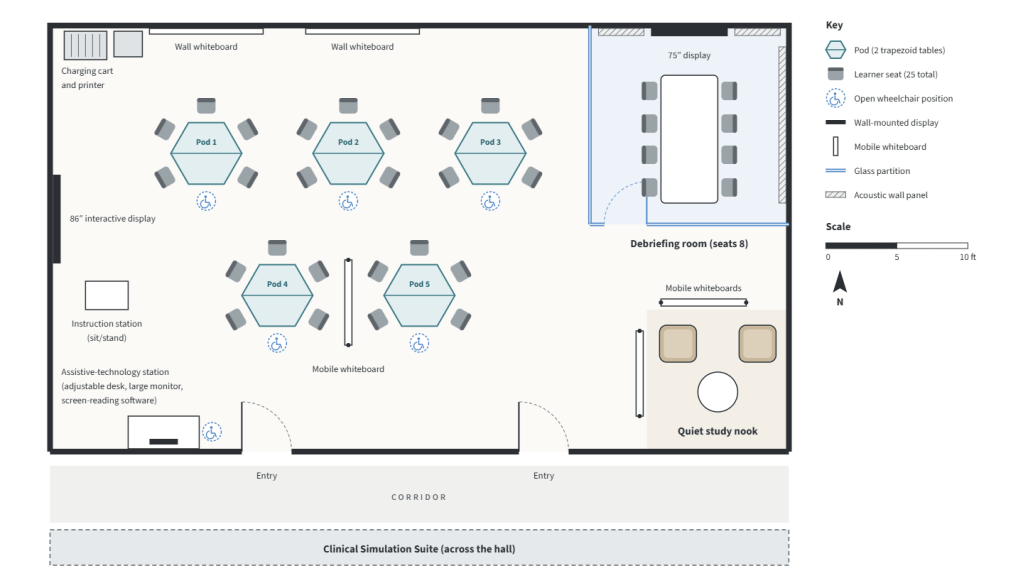
The proposed $60,000 lab will serve 25 learners at a time. Its design supports active learning by giving students room to collaborate, practice individually, and discuss their reasoning.
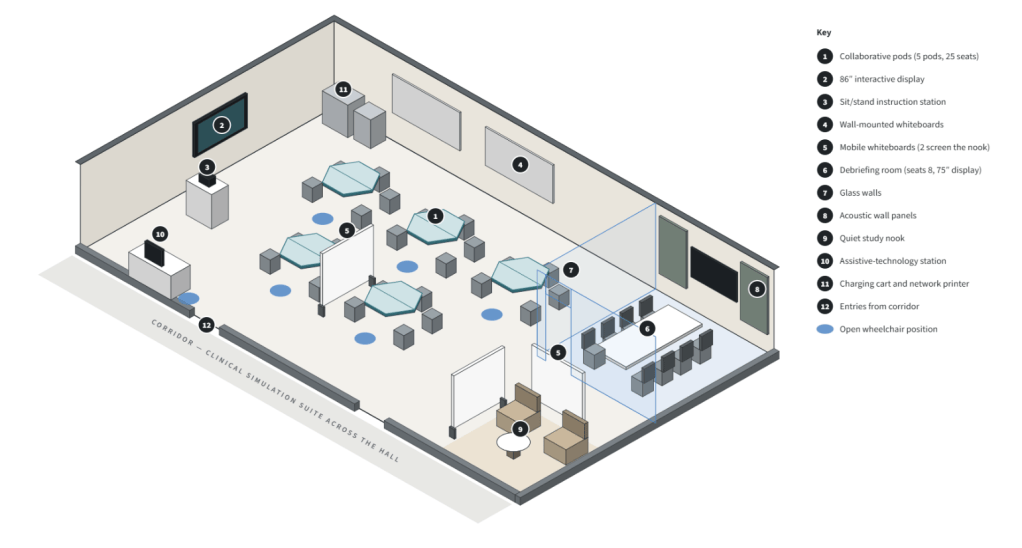
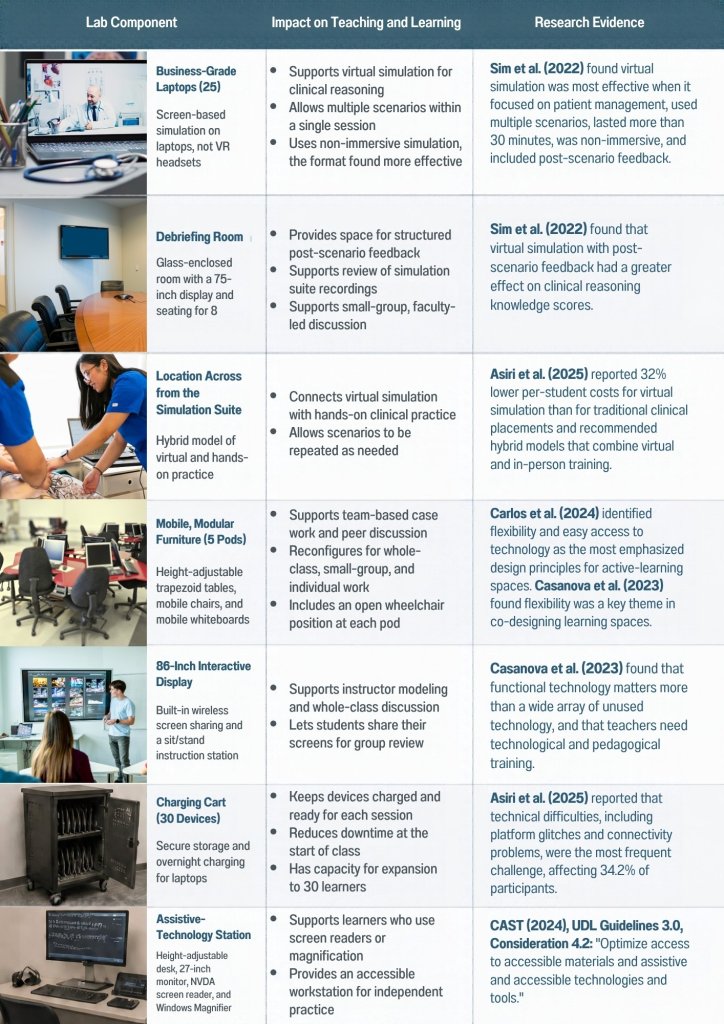
- Five flexible pods: Mobile, height-adjustable tables let students shift between team activities, pairs, and individual work. Flexibility and access to technology are central principles in active-learning spaces (Carlos et al., 2024).
- Simulation and debriefing: Students can move from the clinical simulation suite across the hall to an eight-seat room to review recordings and discuss their decisions. Sim et al. (2022) found that virtual simulation can strengthen clinical reasoning when learners complete multiple patient-management scenarios and receive feedback afterward.
- Access for different learners: Wheelchair-accessible pod positions, a quiet study nook, and an assistive-technology station support varied learning needs, reflecting Universal Design for Learning principles (CAST, 2024).
- Room to grow: The lab starts with 25 seats. Its 30-device charging cart and floor plan allow for a sixth pod; adding five laptops, tables, and chairs would raise capacity to 30 for an estimated $7,548.
Why the design matters
The lab connects virtual practice with hands-on clinical education and structured feedback. Asiri et al. (2025) reported 32% lower per-student costs for virtual simulation than for traditional clinical placements. That finding supports considering simulation as a supplement; it does not estimate the operating costs or savings of this proposed lab. The institution would evaluate the space each term using student simulation performance, lab use, and student and faculty feedback.
What would help learners in your field practice, collaborate, and explain their decisions?
References
Anthropic. (2026, October 4). Computer lab graphics [Generative AI chat]. Claude. https://claude.ai/share/ec48863f-df40-4c23-808e-d91b8f6df56d
Asiri, S., Alqahtani, N., Alzahrani, N. S., Bashatah, A., & Bin Hayyan, F. A. (2025). Evaluating the economic value of virtual simulation-based education post-pandemic: Diagnostic reasoning and clinical decision-making among nursing students. Nursing Economic$, 43(6), 295–302. https://doi.org/10.62116/nec.2025.43.6.295
Carlos, V., Reses, G., & Soares, S. C. (2024). Active learning spaces design and assessment: A qualitative systematic literature review. Interactive Learning Environments, 32(6), 2925–2942. https://doi.org/10.1080/10494820.2022.2163263
CAST. (2024). Universal design for learning guidelines. The UDL Guidelines. https://udlguidelines.cast.org
Sim, J. J. M., Rusli, K. D. Bin, Seah, B., Levett-Jones, T., Lau, Y., & Liaw, S. Y. (2022). Virtual simulation to enhance clinical reasoning in nursing: A systematic review and meta-analysis. Clinical Simulation in Nursing, 69, 26–39. https://doi.org/10.1016/j.ecns.2022.05.006


Leave a Reply